Wednesday, January 5, 2011

A Yoga-lution


I spent a lot of time reading a few books about yoga this weekend. Specifically, Myths of the Asanas and the Sivananda Companion to Yoga. They really got me thinking...

I first found yoga when I was injured and couldn't run for months after my last marathon. At first it was a way for me to exercise when I couldn't run (Vinyasa Power Yoga was my go-to class) but it quickly became something much more than that. As I learned more and more about the stories and the history behind the poses I realized how important is had become to employ yogic philosophies in my own life, to keep myself centered and balanced and always striving to reach my true self. The real change in the way I viewed yoga (a workout vs. a lifestyle) came when a new yoga teacher walked into my yoga studio. Deirdre swept in and took us through the story of Shiva and the origins of the warrior poses (Virabhadrasana I, II and III, the poses for Virabhadra, an incarnation of the Hindu deity, Shiva). She opened the class with chants invoking the spirit of Shiva and ended with 3 long "Oms" that filled the room with energy that I had not previous felt in any yoga practice. In one class I learned more about yoga than in all my previous classes combined. She had my interest piqued.

For the last few months I've been longing to get back to that time in my life when I practiced yoga almost everyday, but I always find myself getting consumed in my running and my need to break a sweat. Sometimes there aren't enough hours in my day for both. Then, there is a part of me that wants my yoga practice to always be an exercise, like running is, but I know it's much more than that and I shouldn't always expect to break a sweat...because I will still reap the benefits. The Sivananda book reinforced just that. One of the biggest point that hit home for me was that it is more beneficial to have a short practice every day than one or two long practices a few times a week.

Well, that's easy enough.

So, I'm really glad Brandon made the suggestion to get up half an hour earlier to have a short practice in the mornings. Not necessarily everyday, but on most days. It's only half an hour, and we don't have to spend 20 minutes getting dressed only to go out in the cold, dark air (like we would for a morning run). I'm happy to report we've practiced for the past three days! Even though it has been a little tough to get through the morning "humbugs", our morning practice has been an incredible blessing for me. It has helped center and ground me before my 45 minute commute and 8+ hour workday (which has been increasingly tough to deal with) and it gives me a special time and space every morning that Brandon and I can share.

It doesn't take long, and it isn't hard. It's just yoga.

and it looks something like this (enjoy the pictures, each one is a link to the original source):

Start in savasana
then, spend a few minutes doing a pranayama breathing exercise (we do anuloma viloma, a.k.a. the "yogi ganster sign")
a few sun salutations (surya namaskar)
an inversion
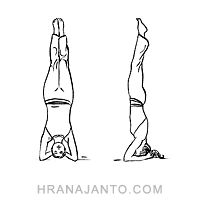
followed by child's pose (balasana)
then a small flow through shoulderstand, plough and bridge
  
cobra, locust and bow (only bow is shown)

a seated forward fold
a twist on each side
one last standing forward fold
triangle pose (trikonasana) on both sides
then, coming full circle and soaking it all in for the final resting pose, savansana


Do you have a go-to home yoga practice? How often do you practice yoga? What is your favorite pose?

Peace, Love & Bagels,

Tuesday, January 4, 2011

Roots in a Wrap


Pigs in a Blanket are the traditional fare for New Year's Eve in my family. Since adopting my Freegetarian diet, I wanted to fix a vegetarian version to go with our nice bottle of wine and early bedtime on New Year's Eve. Since Brandon is the clever on in this relationship, he came up with a cute name and I took care of the ingredients. Roots in a Wrap!

They were surprisingly good! I found a biscuit recipe to use (although it called for butternut squash puree and not applesauce..I was too lazy to cook and puree the squash) and decided on filling them with baby carrots. They were surprisingly delicious! I had a tough time coming up with something to fill the biscuits with that would mimic the texture of a hot dog, originally thinking that a carrot would be too hard. Parboiling the carrots and then baking them into the homemade crescent rolls were just the ticket, they came out a little crunchy but not too hard, and a little bit sweet...the perfect vegetarian stand in for those famously wrapped cocktail hot dogs!

Ladies and Gentlemen, I present to you:

Roots in a Wrap

ingredients:
1 1/8 cup whole wheat
1/2 tbsp. baking powder
1 tsp. fresh chopped rosemary
1/8 tsp. salt
1/8 tsp. pepper
2 tbsp. cream cheese
1/2 cup applesauce
3 tbsp. milk
1 tbsp. brown sugar

about 20 baby carrots (or other root veggie)

method:
Heat oven to 400 degrees F.

In large mixing bowl, combine flour, baking powder, rosemary, salt, and pepper.  Cut in cream cheese, mixing until small crumbs form.  

In a separate bowl, stir squash, milk, and brown sugar until smooth.  Add to dry ingredients, and stir until just combined.  Knead dough 10 times on floured cutting board.  Pat out dough to one-inch thickness and cut into triangles.

In a saucepan, bring water and carrots to a boil for about 3 minutes.

Roll carrots into dough triangles a la pigs in a blanket. Bake on an cookie sheet covered with parchment 10 minutes, until light golden brown.


Peace, Love & Bagels,


Monday, January 3, 2011

Anatomy of a Training Run

Anatomy of a Training Run: the Yasso 800

Anyone that's trained for any long distance race know that there is enough running jargon in one 16-week training plan to fill a dictionary...the Yasso 800 is no different (the workout is the brainchild of Bart Yasso, hence the name).You've probably been living under a rock if you're a runner and you haven't heard of them. At it's simplest, it's just another form of speedwork to enhance a training plan. The more complex explanation: if you want to run a 4 hour marathon, you train to run 800 repeats in 4 minutes each (a 3:30 marathon? run the 800s in 3 minutes 30 seconds, etc.etc.etc.)

In doing a little research on the topic, the Y800s are a pretty controversial subject when it comes to marathon training (you can read more about it here, here, here and here). Some people believe they are a good predictor of your marathon time, many don't, and others like to think they're simply optimistic. There is a lot of disagreement about whether or not they're even a good way to train for a marathon - after all, the energy system your body employs to run an 800 (anaerobic, running at a pace above your lactate threshold) is different than the energy system used for a marathon (aerobic, paces below your lactate threshold). I'm no running coach and I'm not a trained professional, but my training plans always come from a mix of professional running advice, advice from friends and my own experience. It seems like Yasso 800s aren't the BEST way to train for a marathon, but paired with long runs, short runs, pace runs and crosstraining...they become just another tool your marathon training arsenal.

For me, it's all about breaking my marathon up into smaller, bite-sized pieces...because speed intervals are the bane of my marathon training existence. Sure, running mile repeats would be a more effective predictor of my finishing time and maybe even more beneficial in the long haul. I've been through mile repeats and back, though, and I hate them. Yasso 800s are going to give me a chance to change things up. I've said it from the beginning, my marathon training is going to be flexible. If the 800 repeats don't work for me, then I'll try something different. This time around, it's all about listening to my body.

So here's the workout:

Begin running your 800s a few months before your goal marathon
On the first week, do four repeats:
    run 800 in your goal time (a 3:30 marathon translates to a 3 minute 30 second 800)
    jog in between repeats for the same amount of time
Each subsequent week, add one more repeat until you get to 10
Complete your last Y800 at least 2 weeks before race day


Have you used Yasso 800s in your marathon training? What do you think? What other types of speed work do you typically include in training, if any?


Saturday, January 1, 2011

New Year Guacamole y Fruta

Hauoli Makahiki Hou (happy new year!)

Before I get to the best guacamole recipe ever, I want to take a second to talk about my resolutions this year. Normally, I am in the camp of resolving not to resolve but this year there are two things (albeit superficial things) that I want to bring into my new year.

  1. Floss (pretty self explanatory, the world would be a better place if everyone flossed everyday)
  2. Give up sweets for 40 days. This one is a little silly. I don't generally buy into not "letting" myself eat something, but my processed sugar intake has become alarming to me lately. Last year, I gave up cereal for lent (which, at the time, my cereal intake was also rather alarming). So, 40 days and I kicked my cereal habit. I still eat cereal, but I no longer put down an entire box in one sitting. I figure taking a 40 day hiatus from desserts will help me do the same thing, just continue to enjoy them in moderation.
Now, the most important guacamole recipe you'll get all year. Brandon and I made this (among many other NYE appetizers to enjoy with our bottle of wine) and had it with blue corn chips. It quickly became the best guacamole I've ever had...and I know guacamole!

Guacamole y Fruta
inspired by this from the New York Times
make about a cup and a half of delicious guac

ingredients:
1 1/2 ripe avocados
1/4 sweet onion, chopped
1/2 tomato, chopped
1 clove garlic, chopped
1 jalapeno (depending on how spicy you want it)
1/2 apple chopped, any type
seed from half a pomegranate
1 tsp ground cumin
1 tsp chili powder
salt, to taste

method:
Mash the avocado and garlic together until you get your desired guac consistency
Add all of the other ingredients and mix thoroughly
Enjoy with your favorite chips!


What are your favorite New Year's Eve appetizers? Are you making any notable resolutions for 2011?

Thursday, December 30, 2010

Anatomy of a Training Run

Anatomy of a Training Run: the Run/Walk Run


One "different" type of run that I'm following in my marathon training is the Run/Walk run. At a very basic level, it's just interval training: run for an allotted amount of time, walk for an allotted amount of time. 


I scoffed when I first read about run/walk training, thinking, "doesn't that defeat the purpose? I'm a runner for pete's sake!" Walking was the enemy in my training runs. It made me feel like less of a runner...lower on the B.A. scale. Well you know what? I was a runner, but one that was all too often plagued by injury. I'll be the first to admit, thinking that way was just plain stupid.


First, let's walk through some of the benefits:

  • decreased chance of injury
  • the mental benefit of breaking longer runs up into segments
  • interval training often equals maximum results (be it a time goal, distance goal, etc.) many people have even PR'ed by following a run/walk training plan
  • if you're trying to lose weight, intervals actually burn more calories and fat
According to Runner's World, Jeff Galloway pioneered the idea of taking frequent walk breaks during marathons and marathon training and it has been used successfully by thousands of marathon runners. So how does it work? ...and more importantly, why?


"By using muscles in different ways from the beginning, your legs keep their bounce as they conserve resources. When a muscle group, such as your calf, is used continuously step by step, it fatigues relatively soon. The weak areas get overused and force you to slow down later or scream at you in pain afterward. By shifting back and forth between walking and running muscles, you distribute the workload among a variety of muscles, increasing your overall performance capacity. For veteran marathoners, this is often the difference between achieving a time goal or not. Walk breaks will significantly speed up recovery because there is less damage to repair. The early walk breaks erase fatigue, and the later walk breaks will reduce or eliminate overuse muscle breakdown." (source)

There are a lot of different ways to utilize run/walk training. I generally follow a 4 to 1 ratio (in minutes) of running to walking, but my marathon training will be structured as follows:

Weeks 1-4: run/walk ratio of 3:2 on some weekday runs and long runs
Weeks 5-9: run/walk ratio of 4:2 on some weekday and long runs 
Weeks 10-18: run/walk ratio of 4:1 on some weekday and long runs

You can also structure your run/walk training based on your pace:

8 min/mi—run 4 min/walk 35 seconds
9 min/mi— 4 min run-1 min walk
10 min/mi—-3:1
11 min/mi—2:30-1
12 min/mi—-2:1
13 min/mi—-1:1
14 min/mi—30 sec run/30 sec walk
15 min/mi—30 sec/45 sec
16 min/mi—30 sec/60 sec

(source)

You don't have to follow such a regimented run/walk plan either, if spontaneity is your style. Just take walk breaks early and often. I tend to like the 4:1 run to walk ratio because it breaks those longer runs up into 5 minute segments and sometimes makes it much more bearable. But you don't need to run every single one of your training runs this way. As my own general rule, anything less than 3 miles is pretty much a run all the way run. Between 3 and 6 miles is always questionable...sometimes I like to walk a bit, sometimes run. 6+ miles is where I almost always utilize my walk breaks. If I'm feeling extra good about my run for the day, I'll just take a 1 minute break for every mile I run. It's all up to you and your body, the only advice I can give you is to listen to it! 


If you're stuck on determining your pace, but still want to use this type of training, you'll be happy to know that you generally only lose 15-20 seconds when you take a 60 second walk break. Over the course of 26 miles, this could end up being negligible or even add to your overall time, because you'll be less fatigued and able to put in more effort in those last few miles. Fortunately, Runner's World has a nice little chart to give us all a little bit more pacing information:


If you run a mile in... (Col. A) and then walk 60 seconds, your overall pace will be...(Col. B)
6:00
6:40
7:00
7:37
8:00
8:34
9:00
9:31
10:00
10:29
11:00
11:26
12:00
12:23


Will you use run/walk training in your next training plan? What other training techniques do you employ in order to stay injury free?
Related Posts Plugin for WordPress, Blogger...